News
- Home
- »
- News
 EVENT
EVENT
IMPRESS at 17MCM: Shaping Tomorrow’s Transmission Electron Microscopy
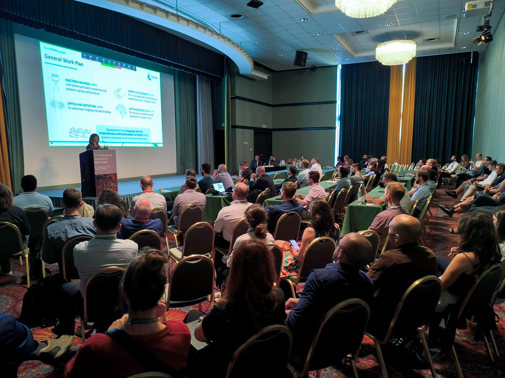
At the 17th Multinational Congress on Microscopy in Portorož, Slovenia, the IMPRESS special session “Shaping the Future of Interoperable TEM” drew scientists into a vivid dialogue on standardization, modularity, and co-creation in transmission electron microscopy.
IMPRESS School 2025: A Week of Cutting-Edge Learning at ALBA Synchrotron
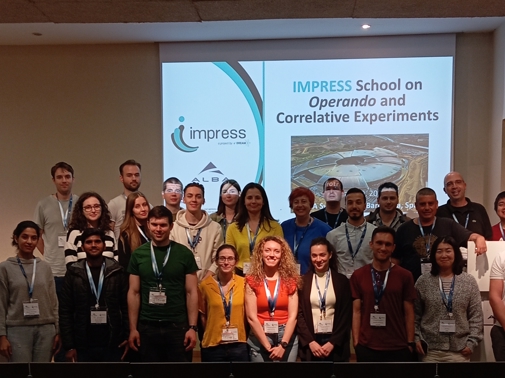
The IMPRESS School on Operando and Correlative Experiments, held from May 5 to 9 at ALBA Synchrotron in Barcelona, brought together 20 selected early-stage researchers from across Europe for an intensive, hands-on training program focused on advanced characterization techniques.
IMPRESS at the 17th Multinational Congress on Microscopy: Special Session on Interoperable TEM
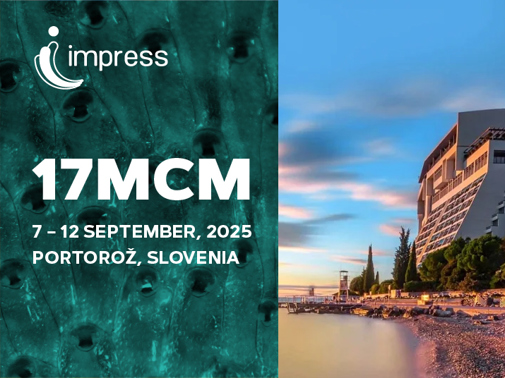
We are proud to announce that the IMPRESS project will be prominently featured at the 17th Multinational Congress on Microscopy (17MCM), taking place from 7 to 12 September 2025 in Portorož, Slovenia. This prestigious event unites leading academic scientists, researchers, students, and industry professionals to exchange knowledge and showcase cutting-edge advancements in microscopy.
 SCIENCE HIGHLIGHT 8
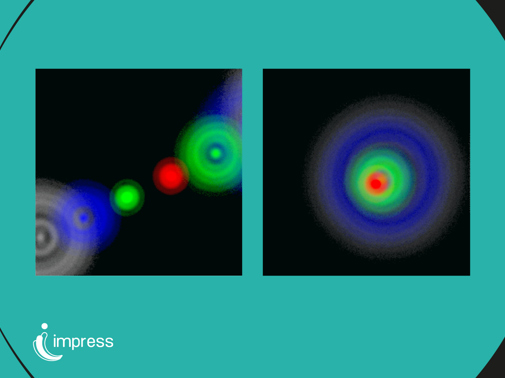
A new AI-driven solution for automating TEM alignment
The integration of artificial intelligence (AI) into scientific instrumentation is more than just a trend, it is a transformative shift. A recent study published in the journal Ultramicroscopy explores the use of AI, particularly convolutional neural networks (CNNs), to automate the process of transmission electron microscope (TEM) alignment.
 SCIENCE HIGHLIGHT 7
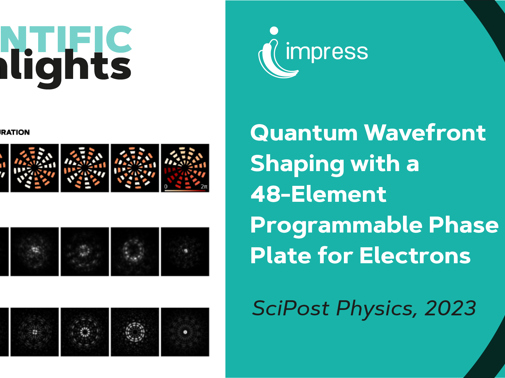
Advancing electron microscopy through an innovative wavefront shaping tool
Wavefront shaping, which involves the spatial and time-dependent control of the phase in coherent waves, has revolutionized a wide range of scientific fields, including astronomy, seismology and telecommunications. Recently, a team of scientists from the University of Antwerp in Belgium, one of the IMPRESS project partners, has presented an innovative phase plate for quantum wavefront shaping in electron microscopes.
 RADIO TALKS
IMPRESS Project Coordinator Regina Ciancio featured on prominent radio science program
On December 10th, Regina Ciancio, Coordinator of the IMPRESS Project, was interviewed on Radar, a weekly RAI Radio 3 FVG program spotlighting the scientific endeavours flourishing in the Friuli Venezia Giulia region of Italy. Regina Ciancio also leads the Laboratory of Electron Microscopy for Materials (LAME), established in 2022 at Area Science Park in Trieste, Italy. This laboratory is at the forefront of characterizing materials to advance scientific knowledge and find new solutions for innovative applications in a variety of fields, ranging from microelectronics to energy efficiency and metallurgical processes, to name just a few.