SCIENTIFIC HIGHLIGHT 11
24 February 2026
Unexpected order in a rule-breaking metal
IMPRESS researchers from the Leibniz Institute for Solid State and Materials Research Dresden led a study showing that collective electron behaviour remains predictable even in a metal long thought to defy conventional descriptions.
When a laptop heats up during video editing, data analysis, or gaming, the warmth you feel is a reminder that not all electrical energy ends up doing useful work. Some of it is lost as heat, as electrons scatter and interact inside the materials that carry current. Engineers spend enormous effort managing these losses, because they ultimately limit performance, battery life, and reliability.
Reducing such losses requires more than better cooling systems or smarter software. It demands a deeper understanding of how electrons behave inside materials, especially when they move collectively. Understanding this collective behaviour is central to “Optical and acoustic plasmons in the layered material Sr₂RuO₄,” published in Nature Communications in May 2025 by a group of scientists led by IMPRESS researchers from the Leibniz Institute for Solid State and Materials Research Dresden.
When electrons move as a crowd
In solids, electrons can sometimes act in concert, forming collective waves known as plasmons. These charge oscillations are a well-established feature of conducting materials and play an important role in how solids respond to electromagnetic fields and transport energy.
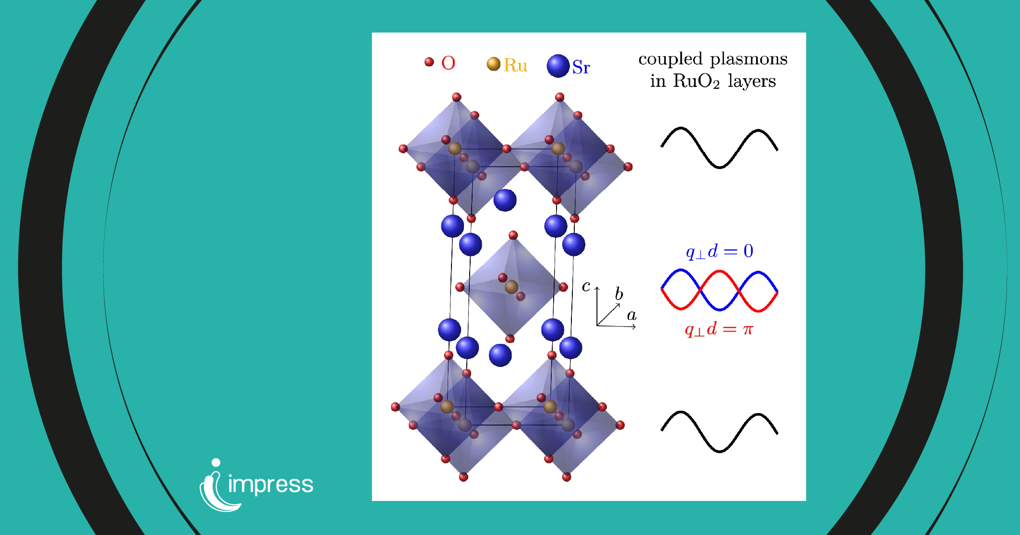
The material studied here, Sr₂RuO₄, provides a particularly clean system to examine this behaviour. It has a layered crystal structure, with electronically active planes stacked on top of one another, and it undergoes a marked change in electronic character. At low temperatures it behaves like a conventional metal, well described by standard theory. At very high temperatures, however, it enters a so-called strange-metal regime, where familiar rules, such as how electrical resistance depends on temperature, no longer apply.
Using transmission electron energy-loss spectroscopy, the researchers followed how collective charge excitations propagate both within individual layers and between neighbouring layers. This allowed them to clearly distinguish two well-known forms of plasmonic motion in layered materials. In optical plasmons, charge oscillations in adjacent layers move in phase, reinforcing one another. In acoustic plasmons, the oscillations in neighbouring layers move out of phase, partially cancelling their electric fields. Phase shifts between fully in phase and out of phase oscillations show intermediate forms of optical and acoustic plasmons.
The key finding: order where disorder was expected
The central result of the study is how robustly they behave. Contrary to predictions from some theoretical approaches to strange metals, the researchers find no evidence that plasmons in Sr₂RuO₄ are intrinsically overdamped or short-lived.
Instead, both optical and acoustic plasmons remain well defined and predictable across a wide range of energies and momenta. Their dispersions are smooth and consistent, allowing the collective excitations to be tracked unambiguously. Only when the plasmons enter regions where decay into individual electron–hole excitations becomes unavoidable do they lose coherence, reflecting a fundamental physical constraint rather than a breakdown of collective order.
Why this matters
These findings refine our understanding of what “strange” means in strange metals. They show that unconventional transport properties do not automatically imply disordered or uncontrollable collective dynamics. Even in regimes where standard descriptions begin to fail, collective electron behaviour can remain structured, coherent, and accessible to predictive modelling.
Although Sr₂RuO₄ itself is not used in laptops or other everyday technologies, it serves as a benchmark system for understanding how electrons behave when they move together. Those insights extend far beyond a single material, informing how scientists think about energy loss, charge screening, and collective excitations in complex solids.
Electron microscopy uses electrons as probes to study matter, and many of the signals it measures directly reflect the behaviour of electrons inside the material. For transmission electron microscopy in particular, a solid understanding of electron dynamics is therefore essential for interpreting experimental results correctly. In this sense, studies like this one align closely with the goals of the IMPRESS project, which seeks to advance transmission electron microscopy by deepening both experimental capabilities and the physical understanding needed to use them reliably.
Whether in a laptop, a data centre, or future electronic technologies yet to be imagined, understanding these regimes is essential for building the knowledge and models needed to eventually develop and optimise materials that behave more efficiently and predictably.
Scientific Reference:
Schultz, J., Lubk, A., Jerzembeck, F., Kikugawa, N., Knupfer, M., Wolf, D., Büchner, B., & Fink, J. (2025). Optical and acoustic plasmons in the layered material Sr2RuO4. Nature Communications, 16(1), 4287. https://doi.org/10.1038/s41467-025-58978-x