SCIENTIFIC HIGHLIGHT 10
19 January 2026
When atoms leave fingerprints in a twisting electron
By reading how scattered electrons acquire a tiny twist, scientists can separate atomic transitions that once appeared hopelessly entangled.
Much of what we know about atoms comes from interpreting how they respond when disturbed. In electron microscopy, that response is often compressed into a single number: how much energy an electron loses as it passes through a material. For decades, this has been enough to reveal composition, bonding, and electronic structure with astonishing precision. Yet it has also meant that some atomic processes, governed by different quantum rules but occurring at nearly the same energy, have remained difficult to tell apart.
In a study published in Nature Communications in July 2025, a group of researchers led by IMPRESS scientists from Forschungszentrum Jülich and Italy’s Consiglio Nazionale delle Ricerche shows that atoms leave behind more than an energy signature alone. As fast-moving probe electrons pass through a material and interact with its atoms, they can also acquire a minute amount of orbital angular momentum, a twist in their wave-like motion that depends on the specific way an electron inside the atom changes state during the interaction.
When a twist becomes information
This twist is not an incidental detail. In the quantum world, atomic transitions follow strict rules: electrons inside atoms can move only between specific allowed states, and those changes involve not just energy, but also well-defined patterns of motion in space. Some transitions are rotationally neutral, while others involve a change in rotational character. Because angular momentum must be conserved, the passing probe electron is forced to compensate, leaving the interaction with a characteristic twist that reflects the nature of the transition that occurred.
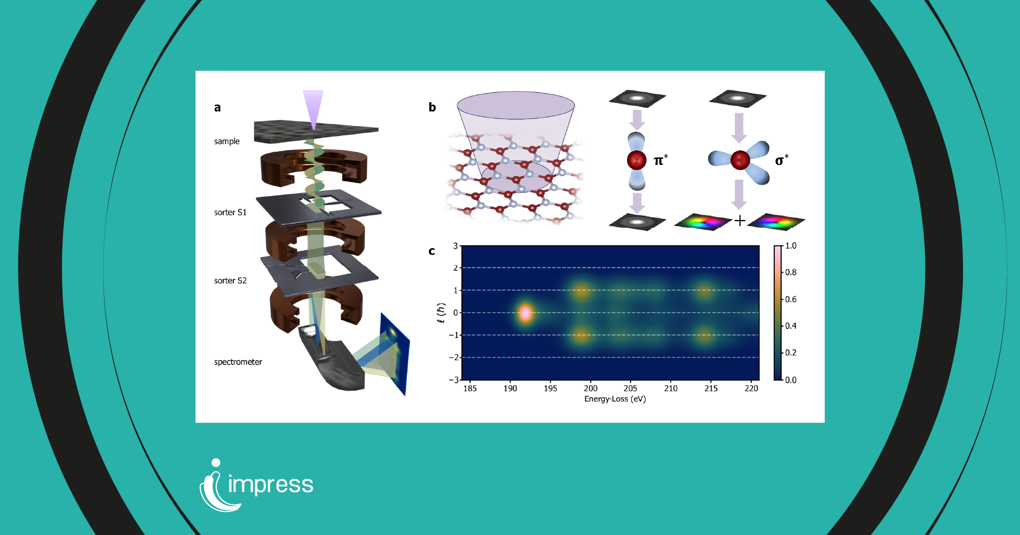
By combining electron energy-loss spectroscopy with an orbital angular momentum sorter, the researchers demonstrate a practical way to measure both quantities simultaneously in a transmission electron microscope. The approach makes it possible to separate scattered electrons according to how much energy they lose and how much they twist as they emerge from the material, producing a two-dimensional picture in which previously overlapping signals can now be disentangled.
When overlapping signals come apart
To demonstrate this, the team studied hexagonal boron nitride, a layered material whose electronic structure includes two distinct antibonding states, known as π* and σ*. In conventional measurements, signals from these states can be difficult to disentangle. Using angular-momentum-resolved spectroscopy, the researchers show experimentally that the two transitions leave different twist signatures in the scattered electrons, allowing them to be separated on the atomic scale. What once appeared as a single, blended feature resolves into distinct contributions, each tied to a different quantum process.
This emphasis on adding new measurement dimensions reflects the broader IMPRESS effort to make transmission electron microscopes more flexible and adaptable, enabling different capabilities to be implemented and combined within a single instrument. In this case, that flexibility makes it possible to read angular momentum alongside energy loss, turning an additional degree of freedom into an experimentally accessible signal.
As angular momentum is closely linked to symmetry, the approach opens paths toward studying magnetic and chiral phenomena with atomic resolution, areas where small changes in the quantum behavior of electrons can strongly influence how a material behaves. More broadly, the work shows that electrons carry a richer record of their encounters with matter than measurements of energy loss alone can reveal. By learning how to read that record, scientists are beginning to access aspects of atomic behavior that were previously folded into a single signal.
Scientific Reference
Tavabi, A.H., Rosi, P., Bertoni, G. et al. Demonstration of angular-momentum-resolved electron energy-loss spectroscopy. Nat Commun 16, 6601 (2025). https://doi.org/10.1038/s41467-025-60804-3