EVENT
IMPRESS at IMC21: Advancing the Technologies Behind Tomorrow’s Microscopes
Held from 31 August to 4 September 2026 at the Liverpool Experience Campus in the United Kingdom, the 21st International Microscopy Congress brought together researchers, technology developers, instrument manufacturers and scientific organisations from around the world.
Organised by the Royal Microscopical Society together with the International Federation of Societies for Microscopy and the University of Liverpool, IMC21 featured a scientific programme spanning 32 symposia across life sciences, physical sciences and instrumentation. Almost 1,700 talk and poster abstracts were submitted, with topics ranging from electron optics and detectors to dynamic microscopy, automation, artificial intelligence and data handling.
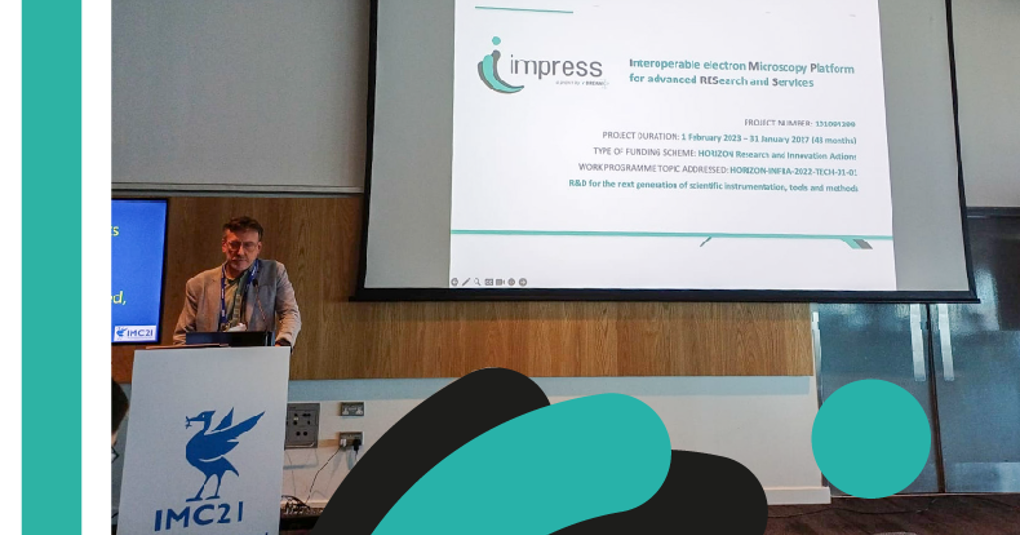
These topics closely reflect the technological landscape in which IMPRESS operates. The EU-funded project is developing an interoperable TEM platform based on common interfaces, transferable sample cartridges and shared data formats. Around this platform, it is advancing electron sources, adaptive optics, event-based detectors, in situ and operando sample environments, and software-supported workflows.
More than a dozen researchers involved in IMPRESS participated actively in IMC21. The selected contributions highlighted here span three important areas in which IMPRESS is active: developing more flexible and interoperable TEM platforms, gaining greater control over the electron beam across space and time, and transforming increasingly complex microscopy data into scientific understanding.
Towards more flexible and interoperable TEM platforms
The next generation of TEM experiments requires more than improvements to individual components. Researchers also need instruments that can accommodate different electron-optical elements, sample environments and experimental configurations - and that allow samples to move between complementary analytical techniques without interrupting the scientific workflow.
A broad perspective on these technological developments was provided by Rafal Dunin-Borkowski in his invited presentation, New Transmission Electron Microscopy Approaches and Hardware Development in the Ernst Ruska-Centre in Jülich. The presentation focused on the wider instrumentation strategy and developments, from tuneable phase plates, electron-beam pulsers and laser–sample excitation to cryogenic specimen stages, ultra-high-vacuum transfer and new microscope platforms for operando, ultrafast, spectroscopic and biological studies, several of which connect directly with the technological directions pursued within IMPRESS.
Across these platforms, cartridge-based sample stages and connections with techniques such as atom probe tomography, FIB-SEM and scanning probe microscopy support more flexible and correlative experimental workflows. Among these developments, interoperable sample-transfer concepts are closely reflecting the IMPRESS goal of developing a standardised cartridge interface that can operate across different instruments and experimental environments.
Controlling the electron beam across space and time
The phase, spatial distribution, timing and trajectory of an electron beam determine how it interacts with a sample and what information can be recovered. Greater control over these properties can open new imaging and spectroscopy modalities while extending the range of processes accessible to TEM.
In Miniaturized Magnetic Multipoles for Ultrafast Transmission Electron Microscopy on the Nanosecond Timescale, Johannes Schultz addressed a specific gap in current time-resolved TEM capabilities. Installed in the aperture system of a TEM, these compact devices can rapidly deflect or focus the electron beam, enabling the investigation of processes such as magnetisation dynamics and GHz electronic phenomena.
The work contributes to the broader development of ultrafast electron-beam manipulation within IMPRESS, including electric, magnetic and cavity-based approaches for probing dynamic phenomena at the nanoscale.
Control over the spatial structure of the beam was the focus of Vincenzo Grillo’s invited presentation, Electron Beam Shaping: New Paradigms and Applications. The approaches discussed included angular-momentum-resolved electron energy-loss spectroscopy, ptychography, quantum-state tomography and more accessible forms of aberration correction.
These beam-shaping approaches connect with IMPRESS developments in phase manipulation and advanced detection, combining novel phase-shaping technologies with event-based detectors to increase the information retrieved from each electron-scattering event.
New optical concepts also require efficient tools for predicting how electrons will propagate through complex systems. Axel Lubk’s poster, EFLY – a Fast Versatile Charge Particle Optics Simulation Code, presented an open-source framework for calculating electron trajectories and aberrations and optimising components such as lenses and multipoles.
Together, the three presentations illustrated complementary aspects of electron-beam control: manipulating its timing, tailoring its spatial structure and designing the optics required to put these concepts into practice.
From complex data to scientific understanding
Event-driven detection is changing how data are acquired in TEM. Rather than integrating electrons into conventional image frames, these detectors register individual events together with positional and temporal information.
In his invited presentation, High-Speed Diffraction-Based Imaging, One Electron at a Time, Jo Verbeeck showed how hybrid pixel detectors can collect tens of thousands of diffraction patterns in less than a second. Combined with real-time processing, this supports applications such as low-dose ptychography, 4D-STEM and immediate experimental feedback—areas already being advanced within IMPRESS. The work is closely connected to IMPRESS developments in event-driven detection, where recording individual electron events with high spatial and temporal precision opens new possibilities for data-efficient acquisition and advanced imaging approaches.
Alongside advances in how microscopy data are acquired, increasingly sophisticated approaches are also needed to extract physical and materials information from complex datasets. Marc Botifoll’s presentation, AI-Assisted Workflow for TEM: From Data Analysis Automation to Materials Knowledge Unveiling in Quantum Materials, demonstrated a workflow combining established computational approaches with supervised and unsupervised machine learning. The workflow automates the analysis of composition, crystallographic phase, orientation and strain in TEM and STEM data. The extracted information is then used to construct models and simulations that provide insight into the structural and functional properties of complex devices.
Within the broader IMPRESS technology landscape, such approaches illustrate how automation and machine learning can help transform increasingly complex microscopy datasets into interpretable scientific information. Taken together, these contributions show IMPRESS researchers working across interconnected areas of TEM development: from flexible instrument architectures and advanced electron-beam control to event-based acquisition, simulation and AI-assisted analysis.
IMC21 provided an international stage for these advances, but its value extended well beyond visibility. By bringing together actors from across disciplines, the congress created opportunities for knowledge exchange, new connections and the cross-fertilisation of ideas. For IMPRESS, this interaction with the wider microscopy community – spanning researchers, technology developers and instrument manufacturers – provides an important opportunity to exchange ideas, strengthen collaborations and connect the technologies being developed within the project with emerging needs and directions in electron microscopy.
News published on: 4 September 2026